
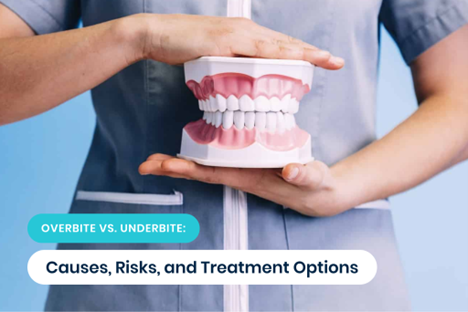
Approximately two-thirds of the U.S. population has a clinically meaningful malocclusion, requiring medical treatment. A malocclusion refers to a poor bite where the upper and lower teeth don’t align properly.
There are two main types of malocclusions, overbites and underbites. Most bite problems begin in childhood, and it’s best to address them then. Below, we’ll compare overbite vs. underbite and let you in on the available treatments.
Key Takeaways
- Overbite and underbite malocclusions are not just cosmetic issues—they can lead to serious dental health problems and should be treated as soon as possible.
- Underbites are less common in the U.S., occurring in less than 5% of the population.
- Malocclusions are easier to treat at a young age, so parents are advised to seek medical attention for their kids while their jawbones are still growing.
- A qualified dental health practitioner should oversee malocclusion treatment.
- There are several treatment options for misaligned bites available to kids, teenagers, and adults.
Overbite vs. Underbite: What’s the Difference?
The difference between overbite and an underbite is in the jawbones they affect. One relates to a protruding maxilla, the upper jawbone, while the other is characterized by an extended lower jaw (mandible).
What Is an Overbite?
An overbite is a malocclusion whereby the upper front teeth overlap the bottom teeth. It’s also referred to as buck teeth or deep bite.
Naturally, most people have overlapping top teeth, with only a small percentage of the population having a perfect bite. This overlapping becomes of medical concern when it’s more than 3mm [1].
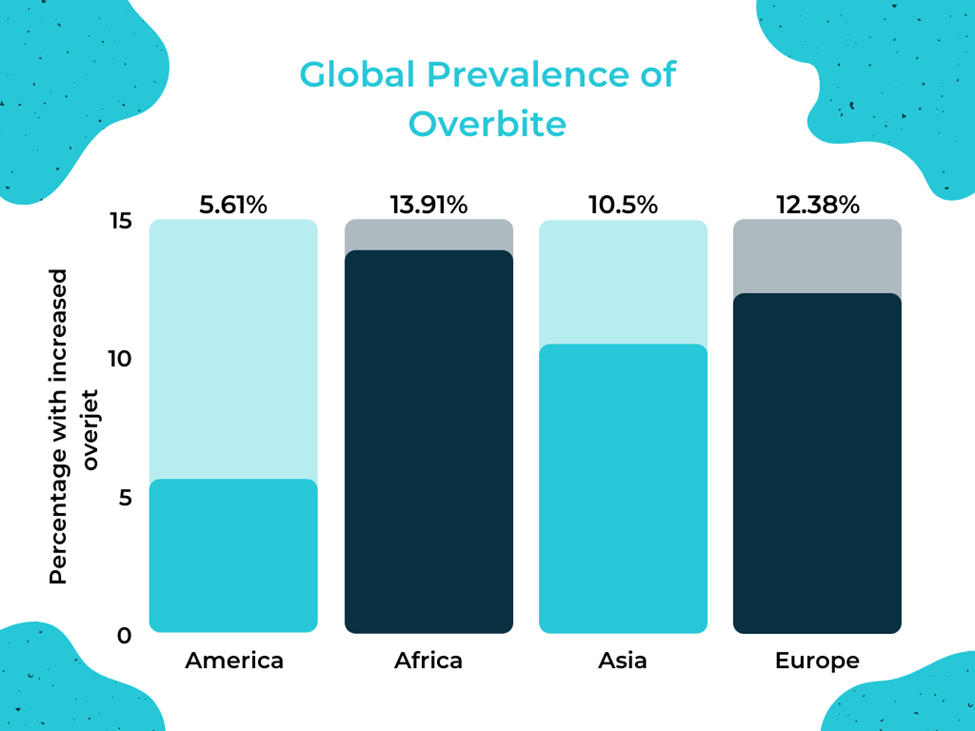
Overbites were most common in Africa with 13.91% and Europe with 12.38%
What Is an Underbite?
An underbite malocclusion is when the lower front teeth protrude beyond the upper teeth, causing a misaligned bite. While a slight overlapping of the upper teeth is common and nothing to worry about, any kind of underbite should be taken seriously and treated as quickly as possible.
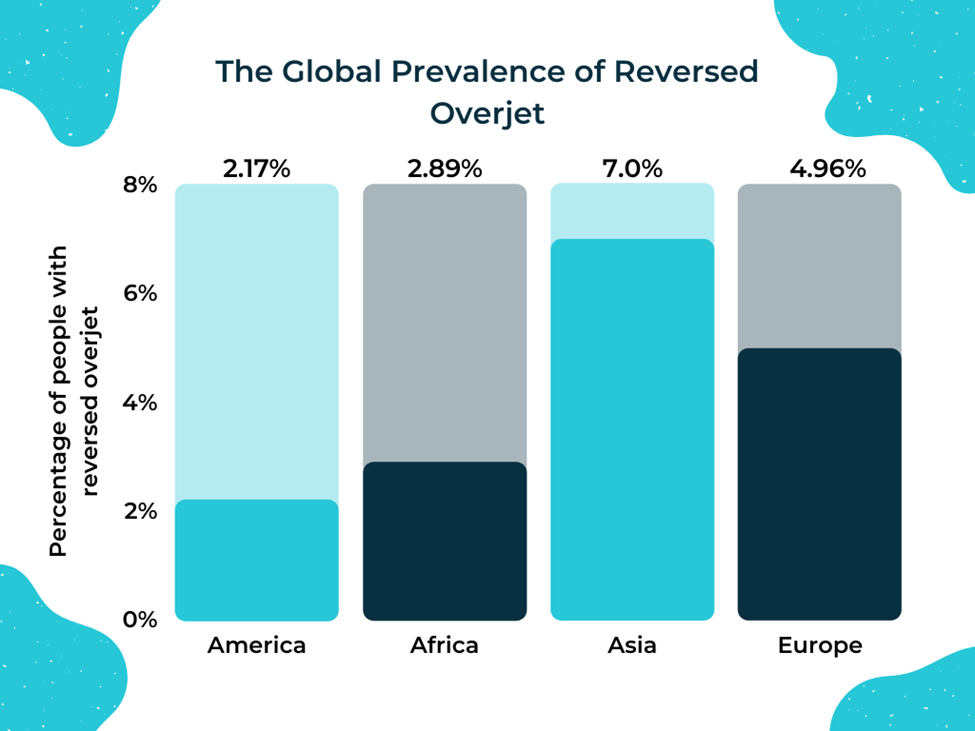
Reverse overjet is most common in Asia at 7%, and least common in America with only 2.17% affected
What Causes Malocclusion?
Several factors cause alignment issues in the upper and lower jaw. A common cause is an abnormal difference in the size of the jawbones, causing one to elongate more and extend past the other.
This misalignment can also occur when the teeth are too big for the jaw, resulting in a protruding appearance. Overcrowded or crooked teeth can also cause malocclusion.
Along with jaw and teeth size, malocclusion happens due to genetics, childhood habits, ill-fitting dental fixtures (crowns, braces, and retainers), and severe injuries [2].
Childhood habits behind misaligned bites include thumb-sucking, nail-biting, late bottle-feeding (beyond infant years), and pacifier use past three years [3].
A tumor in the mouth or jawbone can also result in an overbite or an underbite.
There’s a third type of malocclusion, known as a crossbite. Crossbite occurs when the upper front teeth or back teeth sit inside the bottom teeth. Genetics is the main cause of crossbites.
Potential Risks Associated With Malocclusion
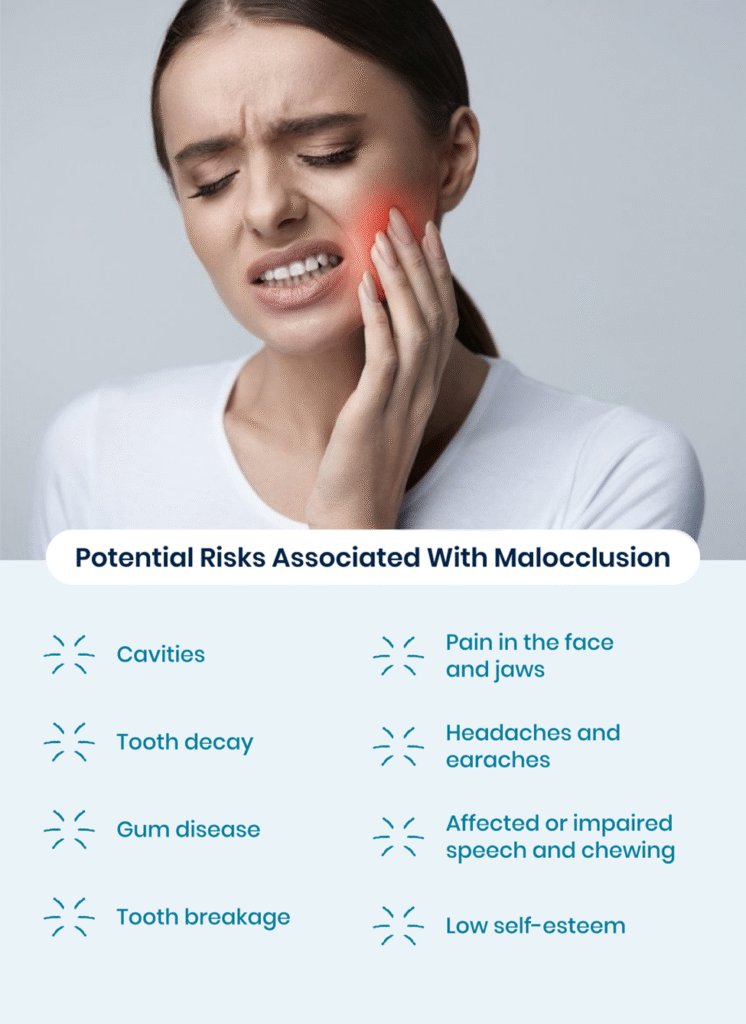
For many people, especially those with a slight overbite, a bite problem is a minor cosmetic issue. But for others, malocclusions present various dental issues and mental health risks.
Oral health risks associated with a misaligned bite include cavities, tooth decay, gum disease, and tooth breakage [4].
The strain on both teeth and jawbone also presents the risk of pain in the face and jaws. Many people experience headaches and earaches. In severe cases, speaking or chewing are challenging because of the poorly positioned teeth.
Misaligned bites often alter one’s facial structure, which can be a big blow to their self-esteem. It gets worse when a person has speech impediments due to an extended jaw.
Treatment Options
Fortunately, several treatment options are available for kids, teenagers, and adults with overbites or underbites. The ideal treatment depends on the severity, age, and other factors that a dentist or experienced orthodontist can identify.
Overbite Treatments
There are several methods orthodontists use when treating overbites, including:
- Braces.
- Surgery.
- Splint therapy.
Braces
Braces are one of the most common treatments used to fix overbites. Here, you have a choice between metal and ceramic overbite braces[8] . Ceramic braces have a clear appearance, making them less noticeable in the mouth than metal ones.
The braces have brackets that provide constant and consistent pressure, gradually forcing the teeth into straightening and realigning perfectly on the jawbone.
You may need to wear your braces for a year or up to three to achieve good results. People with more severe overbite need to wear them for a longer period [5].
Surgery
When an overbite is severe, it requires more complex treatment, and jaw surgery may be the best option. Overbite surgery is an excellent choice when the malocclusion involves misaligned jawbones. The objective of the surgery is to modify the size of the jaws, so they align in the correct position.
The surgeon splits the upper jawbone during the surgery, removes some of the bone, then moves it to align with the lower teeth. They then use bone plates, screws, and wires to hold the jaw together.
Splint Therapy
A splint is a dental device worn over the bottom teeth to move the mandible forward, decreasing the gap between upper and lower rows. The type of splint used for overbite treatment is known as a repositioning splint.
Splint therapy is often a short-term solution your orthodontist might prescribe before moving on to more complex treatment.
Underbite Treatments
Some underbite treatments resemble those used to fix overbites, like braces and jaw surgery. But there are also other options that are only used to treat severe underbites, such as tooth extraction and devices such as a reverse-pull face mask and upper jaw expander.
Braces
As with overbites, braces are used for aligning and straightening teeth on the lower jawbone. The braces apply pressure to the protruding teeth, forcing them back to align properly with the top teeth.
Underbite braces include different types of braces, from traditional ones with metal brackets individually cemented to each tooth, to removable invisible braces and ceramic braces with a clear appearance.
Reverse-Pull Face Mask
When the lower jaw develops more rapidly than the upper jaw, severe cases of underbite occur. A reverse-pull face mask is a device used to slow down the lower jaw growth and allow the maxilla to catch up.
This treatment option is viable for children whose jawbones are still developing.
The mask comprises a metal bar that wraps around the head, fixed to soft pads resting on the forehead and chin. The metal frame connects to braces set on the upper back teeth and upper front teeth. The device works by pushing the top jaw forward, extending it to reduce the space between it and the mandible.
Tooth Extraction
Tooth extraction as an orthodontic intervention for underbite is often used on kids with milk teeth. Extracting a tooth leaves room for permanent teeth to grow, avoiding overcrowding caused by late baby teeth shedding, which often results in underbites.
Upper Jaw Expander
When the upper jaw’s growth rate doesn’t match the lower jawbone, an expander helps to alter its shape and size for proper alignment.
The upper jaw expander is fitted across the palate and widened at intervals throughout the time one wears it. With time, the upper teeth extend outwards, aligning with the lower front teeth.
Surgery
Surgery is used to shorten the lower jaw or lengthen the upper jaw as a treatment option for underbites. To do this, the surgeon breaks the jaw, removes some bone tissue, then repositions it so it aligns properly.
There are two types of jaw surgery used for underbite treatment: regular orthognathic surgery and Le Fort osteotomy. Orthognathic surgery is when the oral surgeon extracts part of the jaw bone to fit it into an optimal position.
During Le Fort III osteotomy, surgeons reposition the cheeks, orbit, and top jaw to fix severe underbite malocclusion.
Can Clear Aligners Fix Malocclusion?
Yes, clear aligners such as Invisalign for overbite can fix malocclusion and make teeth align properly. But, as with other types of treatments, their effectiveness depends on the severity of the misalignment. Aligners are great for mild to moderate alignment issues—but you need to wear them at least 22 hours each day for good results.
Clear aligners work the same way as braces, providing pressure to the teeth. However, they have several advantages over traditional braces, the first being that you can remove them when eating or brushing your teeth. Second, they’re transparent, so they are not as noticeable as traditional braces.
Also, aligners have been proven to have a shorter treatment duration compared to traditional braces [6]. One of the best options on the market is Smileie aligners, which you can use to fix a slight overbite. These are high-quality at-home aligners that are easily accessible, affordable, and convenient because you can remove them whenever necessary. Check out Smileie aligners for more information.
Aligner Co invisible aligners are also a great option that allows you to work towards regaining a healthy smile from the comfort of your home. Check out AlignerCo review to learn more.
It is worth pointing out that the American Dental Association and Association of Orthodontists don’t approve of mail-order aligners at this time. However, they are convenient, affordable, and safe to use as long as you choose a brand supervised by professionals.
How Long Does Treatment Take?
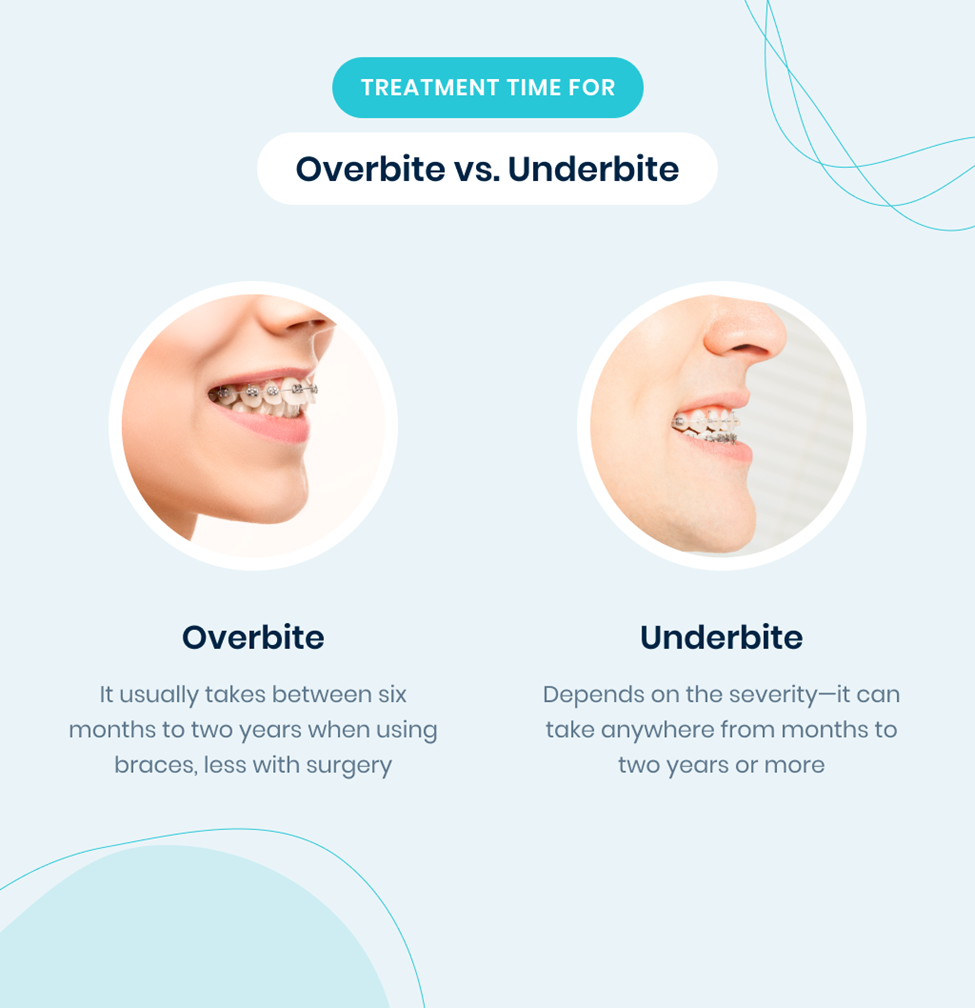
The orthodontic treatment period for overbites and underbites varies depending on the method used and the severity of the condition, but can range from six months to several years.
Overbite
Treating an overbite usually takes between six months to two years when using braces. If you get surgery, it might be less. It ultimately depends on your condition, and an experienced orthodontist will be able to let you know when it’s fine to quit medical treatment.
Underbite
The treatment period for misaligned bottom teeth also comes down to your condition and the type of treatment. Your child may have to use devices like the reverse-pull face mask for up to a year or wear braces for two or more years.
FAQ
You can tell whether you have an overbite or an underbite by observing how your teeth meet when you press them together. It’s an overbite if your upper teeth overlap the bottom teeth by more than 3mm. You have an underbite if the lower teeth extend beyond the other teeth on the top jaw. Symptoms that can further alert you of bite problems are popping jaws, difficulty biting, headaches, and facial pain.
Yes, overbites are more common than underbites. More than two-thirds of American adults have bite problems, but only about 5% of the population have an underbite [7] [8].
If your overbite poses a risk to your oral or overall health, you should fix it so that your teeth align.
You can’t fix an overbite without the help of a professional, but you can stop the progression of your overbite by stopping bad oral habits that cause the misalignment. Such habits include thumb-sucking and chewing nails. You’ll have to visit a dentist who’ll provide medical advice for other cases.
Conclusion
Overbites affect the top teeth, while underbites involve the lower jaw. Early diagnosis is important for prompt treatment, so it’s imperative to see the dentist if you think you or your child has a bite problem. While there are many orthodontic treatment options, clear aligners are an excellent option if you are looking for a more flexible treatment.
References:
1. Fattahi, Hamidreza, et al. “Skeletal and Dentoalveolar Features in Patients with Deep Overbite Malocclusion.” Journal of Dentistry (Tehran, Iran), Tehran University of Medical Sciences, Nov. 2014, https://www.ncbi.nlm.nih.gov/pmc/articles/PMC4281184/.
2. Cakan, Derya Germec, et al. “The Genetic Basis of Facial Skeletal Characteristics and Its Relation with Orthodontics.” European Journal of Dentistry, Dental Investigations Society, July 2012, https://www.ncbi.nlm.nih.gov/pmc/articles/PMC3420844/.
3. Moimaz, Suzely Adas Saliba, et al. “Longitudinal Study of Habits Leading to Malocclusion Development in Childhood – BMC Oral Health.” BioMed Central, BioMed Central, 4 Aug. 2014, https://bmcoralhealth.biomedcentral.com/articles/10.1186/1472-6831-14-96.
4. Kolawole, Kikelomo Adebanke, and Morenike Oluwatoyin Folayan. “Association between Malocclusion, Caries and Oral Hygiene in Children 6 to 12 Years Old Resident in Suburban Nigeria – BMC Oral Health.” BioMed Central, BioMed Central, 27 Nov. 2019, https://bmcoralhealth.biomedcentral.com/articles/10.1186/s12903-019-0959-2.
5. Moresca, Ricardo. “Orthodontic Treatment Time: Can It Be Shortened?” Dental Press Journal of Orthodontics, Dental Press International, 2018, https://www.ncbi.nlm.nih.gov/pmc/articles/PMC6340199/.
6. Ke, Yunyan, et al. “A Comparison of Treatment Effectiveness between Clear Aligner and Fixed Appliance Therapies.” BMC Oral Health, BioMed Central, 23 Jan. 2019, https://www.ncbi.nlm.nih.gov/pmc/articles/PMC6343314/.
7. PH;, Asiri SN; Tadlock LP; Buschang. “The Prevalence of Clinically Meaningful Malocclusion among Us Adults.” Orthodontics & Craniofacial Research, U.S. National Library of Medicine, https://pubmed.ncbi.nlm.nih.gov/31152488/.
8. “Class III Malocclusion.” Class III Malocclusion – an Overview | ScienceDirect Topics, https://www.sciencedirect.com/topics/medicine-and-dentistry/class-iii-malocclusion.


francis
This is a fantastic and well-written article. I’m glad I found such a helpful site.