
What Is Dental Indemnity Insurance? Pros, Cons and Comparisons
When searching for dental insurance, you want the most cost-effective plan. This doesn’t only involve the services covered, but also which dentists you can visit and still receive coverage.
If you’re tired of dental plans that provide limited or no coverage for your preferred dentists, dental indemnity insurance might be the right choice for you.
Key Takeaways
- Dental indemnity insurance plans are fee-for-service models that generally allow you to choose your dentist without being restricted to a specific network.
- Dental benefits depend on your policy, although you can generally visit different dentists.
- You usually do not need to choose a primary care dentist.
- No referrals are generally required to see a specialist.
- You may need to pay for treatment first, after which the insurance company reimburses you according to your plan.
What Is Indemnity Dental Insurance?
Dental indemnity insurance is also known as traditional dental insurance. It is a fee-for-service plan and was once one of the most common types of dental insurance. Traditional indemnity policies may be available through employers and certain insurance providers, although availability varies by location and insurer.
What Is an Indemnity Dental Insurance Plan?
Your dentist charges you for each service, without the contractual obligation to reduce their fees that typically applies to dentists participating in PPO networks.
Many indemnity insurance plans reimburse a percentage of your treatment costs. However, preventive and diagnostic services, such as X-rays and routine dental cleanings, may receive higher coverage than major procedures.
Dental indemnity plans generally have tiered coverage. Routine care may be covered at 100%, while you may pay 50% of the cost of crowns out of pocket. As with other types of dental insurance, you may need to pay an annual deductible before certain benefits begin. Your reimbursement may be determined by the “usual, customary and reasonable” (UCR) rates, depending on your policy.
Before starting treatment, you can ask your dentist to submit a predetermination request to estimate the costs. The insurance company will provide an estimate of the expected coverage and your remaining expenses. However, this estimate is not a guarantee of payment. Your reimbursement may be based on UCR rates rather than your dentist’s actual fees.
Summary
Dental indemnity insurance is a traditional fee-for-service model that gives patients greater freedom to choose their dentist, although coverage and reimbursement depend on the policy.
What Is the Difference Between Indemnity and PPO Dental Insurance?
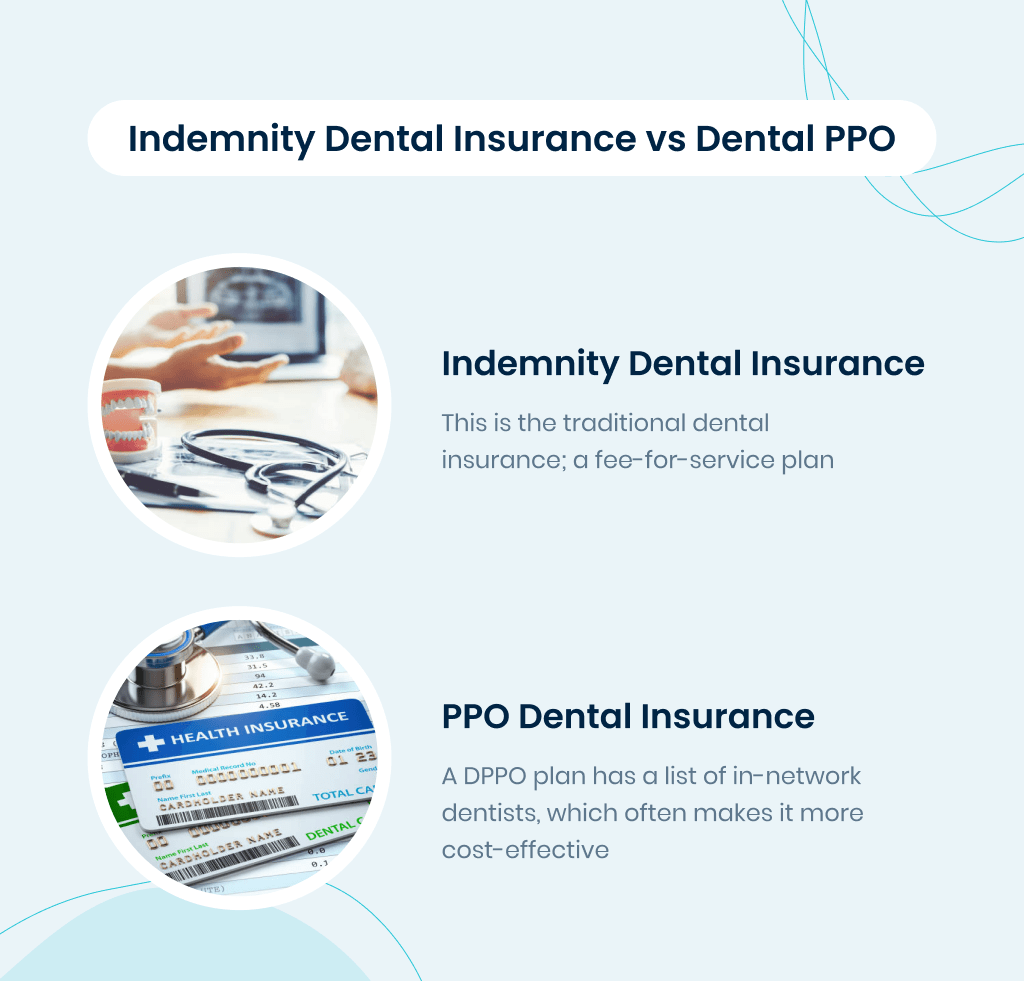
Unlike an indemnity plan, a PPO dental insurance plan has a list of in-network dentists. These dentists agree to specific fee arrangements, which can make treatment more cost-effective than visiting out-of-network practices.
PPO dental insurance plans may also cover treatment from out-of-network dentists, but you generally receive better coverage and lower out-of-pocket costs when visiting an in-network dentist.
However, one advantage of PPO plans is that you may save money on dental services at the time of treatment. With indemnity insurance, you may need to pay the full treatment cost first and wait for reimbursement.
Summary
PPO plans have provider networks and generally offer lower costs when visiting in-network dentists, while indemnity plans offer greater freedom of choice but may require you to pay upfront.
Indemnity Dental Insurance Cost and Prices
Indemnity plans may cost more than dental HMO or PPO plans, but the price depends on the insurer, location, coverage level, and whether the policy is purchased individually or through an employer.
If you’re comparing different dental insurance providers, read our guide to the 8 best dental insurance companies to explore available plans, coverage options, and costs.
For comparison, Aetna currently lists individual PPO plans starting at $22, $26, and $29 per month, with annual maximums of $1,000, $1,250, and $2,000, respectively. These are PPO plans rather than confirmed indemnity policies, but they illustrate how premiums and annual benefit limits can vary between plans. Actual prices and benefits may differ by state.
Before choosing an indemnity plan, check whether major services such as wisdom tooth removal and root canal treatment are covered, as well as the deductible, annual maximum, coinsurance, and any waiting periods.
Here are examples of coverage offered by three major US dental insurance providers:
Aetna’s current individual dental plan listings include the Dental Direct Preferred 2000 PPO, Dental Direct Preferred PPO, and Dental Direct Core PPO. Their listed starting monthly premiums are $29, $26, and $22, respectively. Their annual benefit maximums are $2,000, $1,250, and $1,000.
For these plans, preventive services are listed at $0 when covered in-network. Members pay 20% for basic services under the two Preferred plans and 50% under the Core plan. Major services are listed at 50% for all three plans. The individual deductible is $50, although the actual benefits depend on the policy and location. These figures describe Aetna’s PPO options, not a verified current indemnity policy.
Cigna Dental Indemnity Insurance
Cigna offers dental indemnity plans through certain employer arrangements. Members can generally choose any licensed dentist without selecting a primary care dentist or obtaining specialist referrals.
After meeting the annual deductible and satisfying any waiting periods, members pay a percentage of covered charges, while the plan pays the remaining eligible amount up to its yearly or lifetime benefit limit. Many preventive and diagnostic services receive substantial coverage, but the exact benefits depend on the employer’s policy. Cigna does not provide one universal deductible, annual maximum, or monthly premium for all indemnity plans.
Delta Dental Indemnity Insurance
Delta Dental offers several plan types, including PPO, Premier, and managed-care options. Its Premier plan is described as a managed fee-for-service option, which differs from a conventional PPO network arrangement.
Premier plans may include annual maximums and deductibles, with coverage depending on the policy and location. Because Delta Dental offers different products across states, the exact premium, deductible, annual maximum, and reimbursement percentage should be checked against the current plan documents. A single current price or coverage percentage cannot be applied to all Delta Dental plans.
Summary
Dental indemnity insurance may have higher premiums than some alternatives while offering greater freedom to choose a dentist. However, the actual cost and coverage depend on the specific policy. Compare annual maximums, deductibles, and coverage for restorative and specialist procedures before enrolling.
Indemnity Dental Insurance: Pros and Cons
There are several advantages and disadvantages to choosing dental indemnity insurance over other plan types.
Pros:
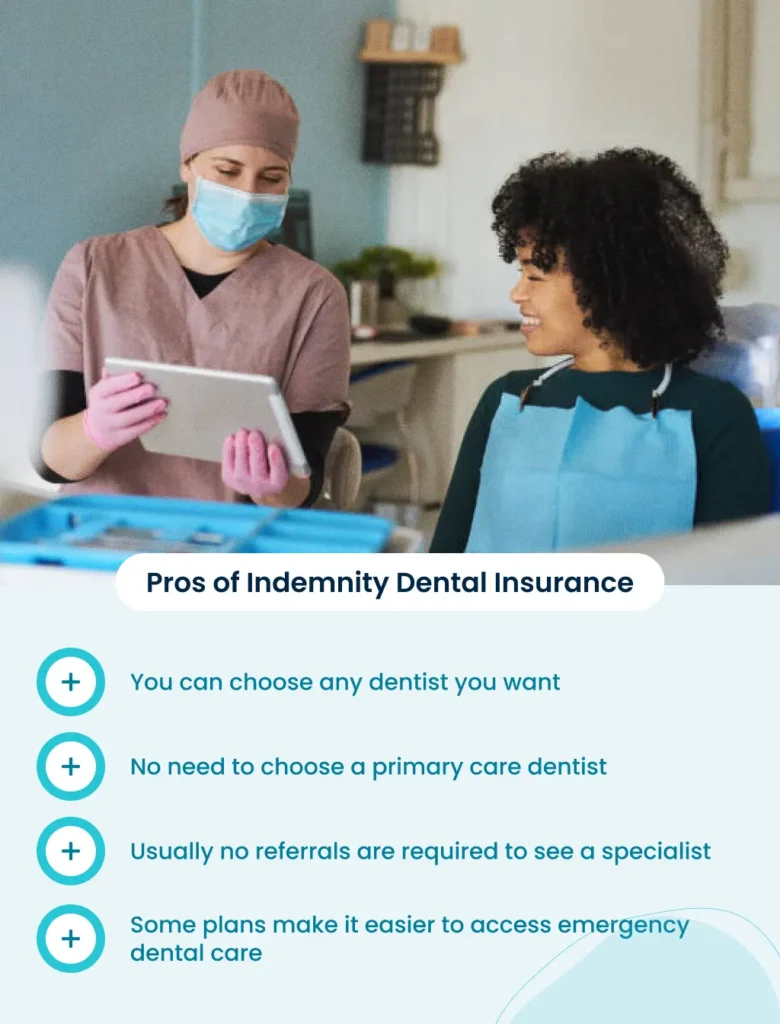
- You can generally choose any licensed dentist without being restricted to a specific provider network.
- You do not usually need to choose a primary care dentist, unlike with HMO dental plans.
- In many cases, no referrals are required to see a specialist.
- Some plans offer flexibility when accessing emergency dental care.
Cons:
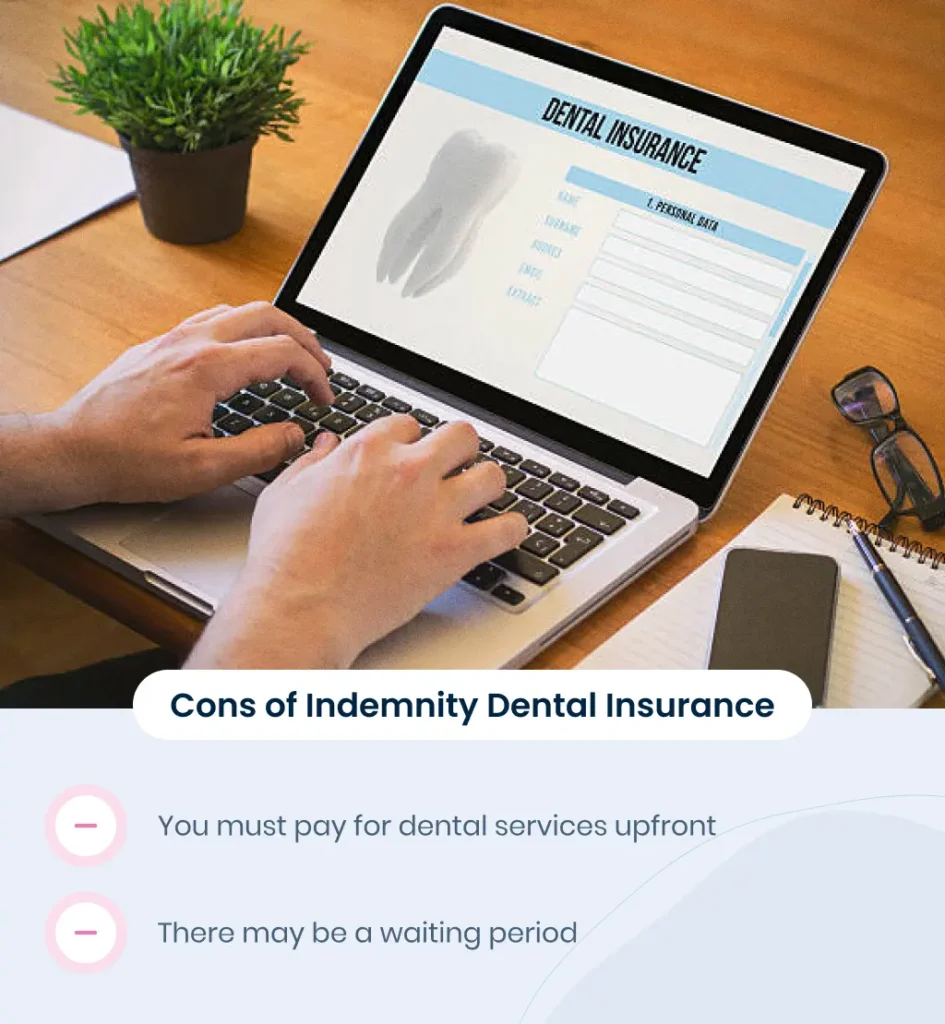
- You may need to pay for dental services upfront and wait for reimbursement.
- There may be a waiting period, especially for major treatments or when you have recently enrolled.
- Premiums may be higher than those of some HMO or PPO plans.
- Annual maximums and reimbursement limits may leave you with additional out-of-pocket expenses.
Summary
Dental indemnity insurance offers considerable freedom when choosing a dentist, with fewer network restrictions, but premiums and out-of-pocket costs may be higher.
FAQ
Dental indemnity insurance is a fee-for-service plan that generally allows you to choose your dentist without being restricted to a specific network. However, reimbursement depends on your policy, and you may need to pay for treatment upfront.
It can be difficult to find dental insurance without a waiting period for major procedures. Some plans may waive certain waiting periods under specific conditions, so check the policy before enrolling.
Dental savings plans are another option. They offer discounted fees through participating dentists and generally do not have insurance waiting periods, but they are not insurance policies.
Dental indemnity insurance generally allows you to visit any licensed dentist in the country without being restricted to a specific provider network. However, reimbursement depends on your policy’s terms and coverage limits.
Cigna offers dental indemnity plans through certain employer arrangements. These plans generally allow you to choose any licensed dentist without selecting a primary care dentist or obtaining specialist referrals. Deductibles, coinsurance, and benefit limits vary by plan.
Delta Dental offers several types of dental coverage, including PPO and Premier plans. Its Premier option uses a managed fee-for-service structure. Available benefits, premiums, and coverage limits depend on the specific plan and location.
Conclusion
If you want the freedom to choose your dentist and potentially access a wider range of covered services, dental indemnity insurance may be right for you.
Indemnity plans are similar to other types of dental insurance in that they require premiums and may impose waiting periods and coverage limits for major services. However, you may need to pay for treatment upfront and wait for reimbursement, which may not suit everyone.

