
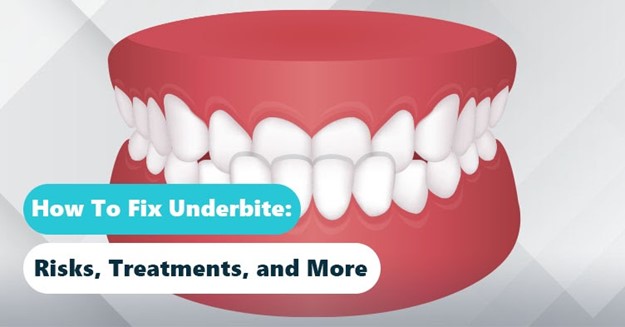
Unfortunately, there are no quick fixes when it comes to dental health. If you’re wondering how to fix underbite, the only answer is to go and see an orthodontist. The treatment might be uncomfortable both for your mouth and wallet; however, if uncorrected underbite can have a serious impact on both your physical and mental health.
What Is An Underbite?
An underbite is a form of misaligned jaw in which the lower jaw is positioned too far forward. In other words, the upper and lower jaws don’t meet correctly because the lower jaw protrudes. It’s more common in people with flat profiles, as even a slightly protruding jaw can be noticeable.
More technically, this condition is known as prognathism. It’s considered a class III malocclusion, the most severe form of misalignment. When comparing overbite vs underbite, an underbite is generally considered a more serious condition.
Sometimes, as the result of severe underbites, the upper palate is underdeveloped and the lower teeth stick out. The misalignment puts tension on the underlying musculature, which pulls the teeth into extreme positions. The upper front teeth may also be angled inward, as a result of the recessed position of the upper jaw.
How Underbite Can Affect Your Health
We may not normally consider a dental condition a vital health concern. However, if sufferers don’t correct underbite, problems will continue to arise throughout their lives. Leaving underbites uncorrected may be contributing factors to health problems like:
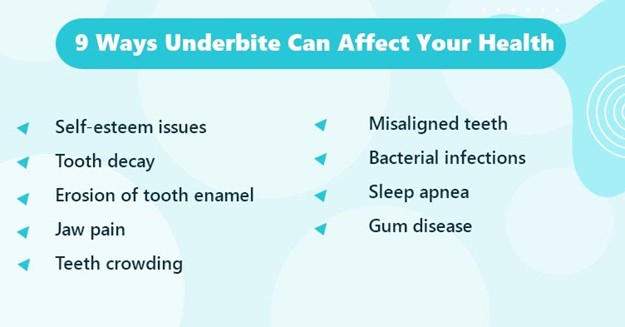
The effects of prognathism can extend beyond a simple bad bite, as unhealthy as that can be. People with an underbite are more likely to have self-esteem issues than people with healthy teeth alignment. However, it is possible to fix underbites, leading to a general improvement in physical and mental health
What Causes an Underbite?
Underbite occurs when either the lower jaw is overdeveloped, or the palate and upper jaw are underdeveloped. The causes might be genetic, environmental, or a mixture of both.
Genetic Causes
Your chances of suffering from an underbite are much higher if a relative also has that problem. Additionally, people of Asian descent are more likely to develop an underbite, as a flatter profile is more common. This is attributed to the role of genetics in development.
Genetics can also indirectly play a role. People with cleft-palate are also more likely to develop underbite. Sufferers of acromegaly or some forms of gigantism may also have higher odds.
Environmental Causes
While genetics can increase the chances of developing underbite, environmental causes play a role. Breathing obstruction, for example, due to allergies, can lead to holding odd positions as a child, which in turn causes problems in development. Trauma, perhaps from an injury, can also be a cause.
Underbite Correction
There are a number of treatment options for underbite correction. They include many non-surgical correction methods.
Some types of braces can help. Frequently, a chin cap or a protraction face mask may be necessary to hold the jaw in the correct position. In other cases, simply repositioning the front teeth can be of benefit.
However, in severe cases, jaw surgery, otherwise known as orthognathic surgery, may be required. This involves shortening the lower jaw to change the jaw line and bring it back behind the upper jaw.
Home Treatment
If you’re wondering how to fix underbite at home, using clear aligners may be your only option.
Correcting underbites means making significant changes. The process should be monitored by a professional to ensure a process that will fix underbites doesn’t create another problem elsewhere.
With that said, there are treatments short of jaw surgery. Children, in particular, can benefit from treatment such as a braces alternative like Byte clear aligners.
Underbite Correction Exercises
There are a number of jaw exercises that focus on tightening and strengthening jaw muscles. It’s possible that using exercises of this sort to, for example, practice bringing lower or upper teeth together correctly may be helpful. It’s unlikely exercises on their own will be a complete solution to fix underbites. More often, they are used after jaw surgery
Underbite Surgery
Orthognathic jaw surgery may be required to correct an underbite in severe cases. The goal of surgical treatment is to set back the lower jaw position, advance the upper jaw, or both. It may mean the removal of one or more teeth, from the lower or upper arch, in addition to the surgery itself. Two procedures are common:
- Sagittal split ramus osteotomy (SSRO).
- Intraoral vertical ramus osteotomy (IVRO).
Both involve altering the jaw bones, which can require long healing and recovery times. You can expect to go home in one to three weeks, but your jaw will be weak for much longer.
Additionally, jaw surgery involves meeting with several specialists including an oral surgeon. As a result, the benefits of orthognathic surgery cost a fair amount.
However, in some cases, surgery may be the only solution to fix underbites. Most people find the results worth the discomfort
Can You Fix An Underbite Without Surgery?
No one has perfectly aligned teeth, but some come closer. It may require less dramatic changes to fix underbites in some cases. It’s possible that braces are enough to correct the lower jaws’ position. An oral health professional can help you make informed choices.
Braces
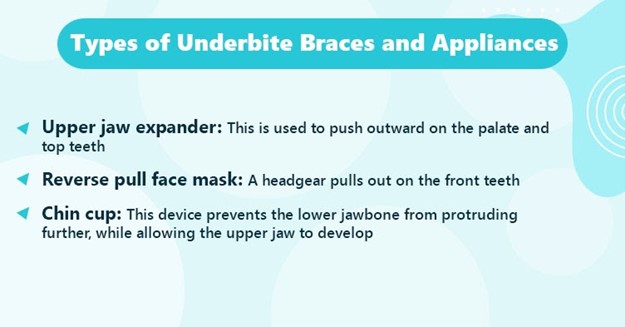
Some non-surgical methods to fix underbites include several types of braces and other appliances. Like regular braces, these devices use mechanical pressure to alter the jaw shape. To fix underbites, however, sometimes pressure has to be applied in unusual ways. Appliances include:
How Do You Solve an Underbite Problem?
In most cases, you go see an orthodontist. Jaw misalignments can cause problems throughout life and need to be treated by an expert. A more severe underbite may require input from other specialists.
Underbite Treatment for Children
A child’s underbite is easier to correct than adults’. Their continuing development can be directed toward the best jaw position. Additionally, bad habits that contribute to problems can be addressed early.
It can be tempting to wait until a child has permanent teeth before considering orthodonture. However, even the development of baby teeth can affect the later development of permanent upper and lower teeth. Addressing problems like underbite early means it’s much easier to achieve even teeth and a beautiful smile.
Can An Underbite Correct Itself?
It’s unlikely that underbite will correct itself without being addressed. However, addressing any bad habits that might be contributing to underbite can be helpful. Removing environmental causes can also be helpful. Braces or other appliances may also be necessary to fix underbites. However, in children, jaw surgery is reserved for the most severe underbite cases.
FAQ
An underbite occurs when the upper front teeth are behind the lower teeth, which can stick out. Genetic causes can contribute to developing underbite. Childhood bad habits or adverse environmental factors may also play a role.
No, an underbite can’t be corrected naturally. There are no herbal remedies or exercises that fix jaw position, but managing habits and environmental factors may help prevent it from getting worse.
Underbites may not get worse in the sense that the lower jaw protrudes further after development has finished. However, health issues can accumulate over time. The least serious issues include tooth decay and gum disease. Joint pain can also grow worse over time.
Like most jaw misalignments, an underbite is often addressed by using braces or other appliances. Mild cases might be addressed by pushing the top teeth out and withdrawing the protruding lower teeth.

