
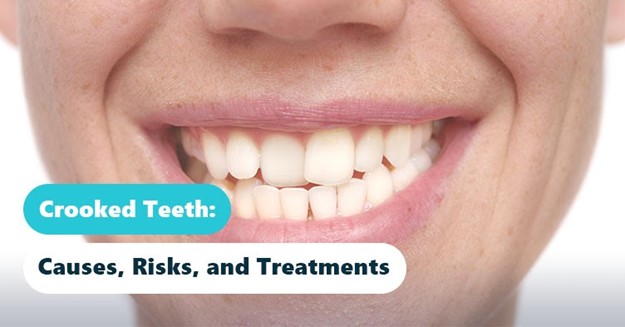
Have you always been unhappy with your smile, but never received orthodontic treatment growing up? Or maybe you’re concerned about your child’s development, as their new teeth just don’t seem to be settling in a straight pattern in line with the jaw and each other.
Crooked teeth are common and can cause dental problems, functional impairment, or dissatisfaction with appearance. Let’s take a look at what causes teeth to become crooked and what can be done to correct misalignment.
What Are Crooked Teeth?
Crooked teeth are a type of dental malocclusion, where the teeth are misaligned. Some people with crooked teeth only have one tooth out of place, while others may have several teeth or all of one or both jaws affected. Serious misalignment can cause pain or difficulty eating or speaking, but mild cases may be barely noticeable
Causes of Crooked Teeth
The main causes of crooked teeth are:
- Malocclusion.
- Jaw size.
- Poor myofunctional habits.
- Poor dental care.
- Poor nutrition.
- Genetics.
- Injury to the face.
Malocclusion
Some types of crooked teeth are known as malocclusions, and often involve a failure of upper teeth to meet lower teeth. The most common type involves the top teeth sitting slightly forward. With an overbite, your upper jaw is positioned forward over the lower jaw, while an underbite features your lower jaw in an extended position.
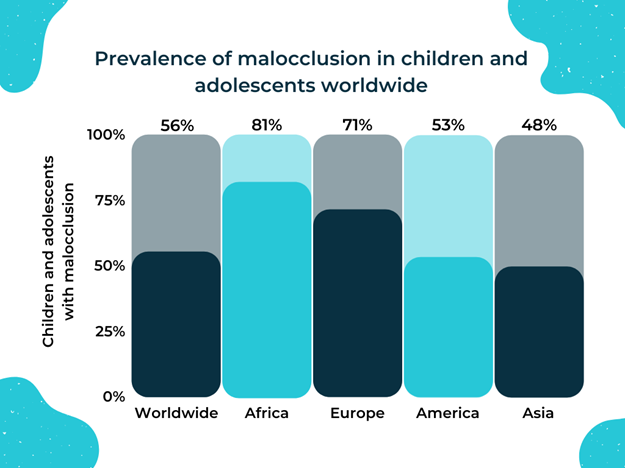
Approximately 56% of children worldwide have malocclusion with the majority (81%) residing in Africa
Jaw Size
A smaller jaw bone can make you more likely to develop crooked teeth. For this reason, women are more likely to have a crowded mouth than men. It was, however, once believed that wisdom teeth were the main factor behind lower front teeth crowding, but this has been disproven

The biggest difference in arch perimeter between crowded and non-crowded teeth, was seen in the men’s group, suggesting that women in general have smaller jaws
Poor Myofunctional Habits
Habits such as thumb sucking, eating on one side only, and tongue thrusting can make teeth crooked as they erupt, through changing the mechanical forces on new teeth.
Myofunctional habits can even affect adult teeth. A case study of a man seeking orthodontic treatment for the second time described successful jaw and teeth straightening after sinus surgery and habit training, as difficult breathing shifted his teeth out of place.
Poor Dental Care
Poor dental care, particularly if it leads to tooth loss, may lead to misaligned teeth. Baby teeth assist the eruption of permanent teeth by acting as guides, and support facial muscle and speech development. Early loss or extraction leads to a loss of this support. Dental care is most important during childhood, as enamel only completes its hardening after eruption
Poor Nutrition
Diets high in processed junk food may affect oral health by impairing bone development. Intake of fat-soluble vitamins is of particular importance. Vitamin D assists in calcium metabolism, for example, while vitamin A activates bone-breaking osteoclasts to remodel bones into their adult form. Vitamin K supports mineral transport into the bones
Genetics
The development of your jaw bone, muscles, tongue, cheeks, and even lips can affect the alignment of your teeth as they erupt. As genes play a major role in these developments, crooked teeth often run in families
Injury to the Face
Injuries can not only break teeth, but push them out of their normal alignment. A study on young children found that just over one-quarter of teeth injuries led to luxation, or misaligned teeth
Potential Issues Caused by Crooked Teeth
Some issues that crooked teeth can lead to include:
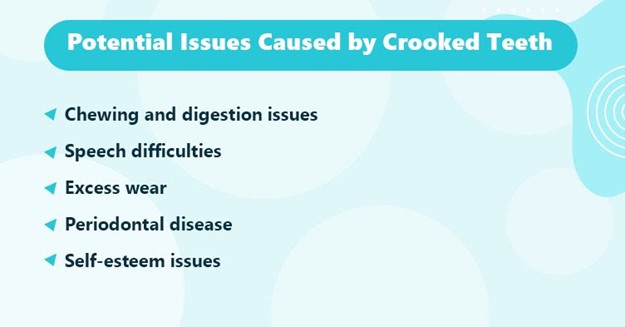
Chewing and Digestion Issues
If your teeth are crooked and do not meet properly, chewing may be difficult, particularly with small pieces of food. Tooth pain as a result of severe misalignment, an increased prevalence of tooth decay, or the teeth digging into your gums or lips causes even more problems with chewing. Among children, pain is linked to an over five times higher rate of difficulty eating and drinking
Speech Difficulties
The positioning of your teeth influences the growth, development, and maintenance of your facial and jaw muscles, particularly in childhood. Additionally, issues such as pain can lead to flinching and guarding of your mouth, which affects speech even further. Children with tooth decay show a 14 times higher rate of speech difficulty for this reason
Excess Wear
As they have less support around them, misaligned teeth are more likely to become damaged in cases of facial injury. Additionally, you may move your mouth in ways that wear your teeth down as a way to compensate for difficulties eating, or even grind your teeth
Periodontal Disease
Severely crooked or crowded teeth may be more difficult to brush, which can lead to tooth decay and even gum disease. For example, severe crowding of the front teeth almost doubles the risk of gum disease, increasing rates by 93%.
Deep overbite in the front teeth, with contact between the gums, and front teeth crossbite increase the risk of gum disease by 40% and 75%, respectively.
Self-Esteem Issues
Many people with misaligned teeth, particularly crooked permanent teeth, are unhappy with their overall appearance. Children and teenagers with crooked teeth are often teased, while adults may feel less confident when speaking in front of others.
Can Crooked Teeth Be Prevented?
Some cases of crooked teeth can be prevented, particularly if you start before your child’s baby teeth come in. Thumb sucking, tongue thrusting, sucking or biting the lips and cheeks, and chewing on one side of the mouth can affect how straight baby and adult teeth are when they erupt
How To Correct Crooked Teeth
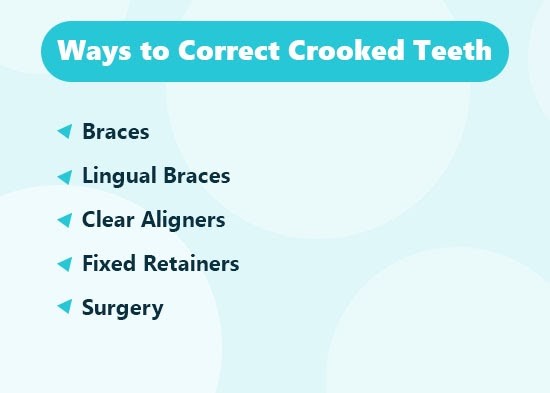
Different types of braces, aligners, retainers, and even surgery can be used to rectify crooked teeth.
Braces
Traditional metal braces are the “classic” treatment for straightening crooked teeth. In fact, they were the only orthodontic treatment for this purpose for many years. Metal braces are made of brackets adhered to your teeth, and arch or flexible wires that hold them together. These are tightened at each appointment to continue the teeth straightening process.
Sometimes, metal ties or rubber bands are added to put more pressure on the teeth to move them into the correct position.
Traditional braces are the most effective of your treatment options. If you don’t like their appearance but need to use them, ceramic braces are a barely-visible alternative to all-metal brackets
Lingual Braces
Lingual braces are a type of “invisible” braces, as they are placed on the inner side of your teeth. They are the most effective type of braces besides traditional brackets, but are more time-consuming to apply.
Clear Aligners
Clear aligners can be effective treatment options in crooked teeth and milder cases of underlying causes such as malocclusion. Research shows they are also generally faster at straightening teeth. Wondering how clear aligners work? We’ve put together a simple overview to help you understand.
Some clear aligner brands allow for orthodontic treatment at home, which is often cheaper and expands access to areas without in-person providers. While the American Dental Association still advises against clear aligners, they can still be effective.
Byte aligners are designed with the principles and practices of cosmetic dentistry to improve your smile. After completing an at-home impression kit, a specialist orthodontist will design a series of aligners that gradually straighten teeth through mechanical force. They can straighten crooked teeth effectively in mild cases of misalignment and malocclusion.
AlignerCo is one of the most affordable aligners available. Unlike Byte, teenagers can qualify for treatment as long as they have no baby teeth remaining. However, personalized support is more sparse, which may contribute to the lower costs.
Fixed Retainers
Wearing a removable or fixed retainer is typically necessary to prevent orthodontic relapse. This is where your teeth return to their original misalignment. Sometimes, your treatment plan will recommend a nighttime aligner, including Byte aligners. You may even need a fixed retainer for months or years after braces, which cannot be removed
Orthognatic Surgery
Surgery may be necessary if your teeth are crooked due to bone malformations. A procedure known as an osteotomy is commonly used for severe malocclusion. Here, your surgeon cuts into the gums behind your top teeth or bottom teeth, depending on where the issue lies. This allows for the jaw to be brought forward or back, and reset with titanium screws or plates.
Is It Necessary To Correct Crooked Teeth?
Not every case of crooked teeth needs to be corrected, as many do not cause issues such as pain or difficulty chewing or speaking. However, if you are insecure about your appearance or your teeth are causing issues, you can choose to have your teeth straightened.
What To Expect When You Visit Your Dentist or Orthodontist
If you or your child has crooked teeth, orthodontic treatment may be necessary. Your orthodontist will begin with a thorough oral examination, assessing tooth alignment and jaw function, including how comfortably you can open and close your mouth. They may also ask questions to help identify possible causes.
Next, diagnostic records are taken, which may include dental X-rays and impressions of the upper and lower teeth. Some practices use advanced digital scanning instead of traditional impressions. Using this information, the orthodontist develops a personalized treatment plan outlining the type of braces or appliances needed, their placement, expected treatment duration, any additional procedures, and realistic treatment goals.
FAQ
Crooked teeth are very common, with an estimated half of all children and teenagers receiving or requiring treatment
If you only have crooked bottom teeth, your orthodontist can focus on this area. Treatment options are ultimately your choice, so you can inform them if you are only unhappy with your lower front teeth.
The average cost of dental braces is almost $5,000, with a range between $1,500 and $10,000 depending on treatment time, the severity of the misalignment, and type of braces used. You can expect the cost to be at the lower end of this scale if you only need braces for crooked bottom teeth.

