
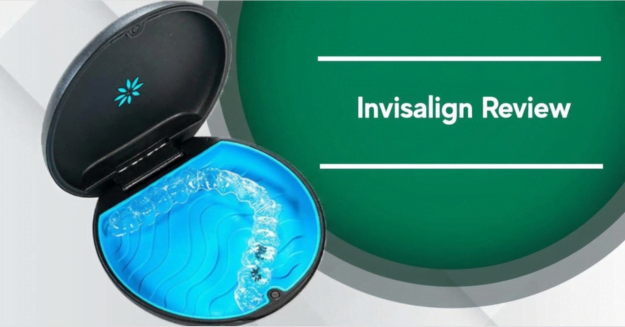
Invisalign Review [2026]: Pros, Cons, Benefits & Results
Let’s be honest. Traditional braces can be noticeable, cannot be removed by the patient, and involve regular visits to the orthodontist.
You want something more comfortable and barely visible that won’t irritate the inside of your cheeks or get food caught around brackets and wires.
Clear aligners may be the best thing for you. One of the best-known options is Invisalign, so how does it measure up in the real world? Let’s look at what the research says about Invisalign and what you can expect from treatment.
How Good Is Invisalign?
Overall Rating: 4.5/5
Editor’s Notes: Invisalign is an established, evidence-supported alternative to traditional braces for many orthodontic problems. However, treatment can be expensive, and you need access to a dentist or orthodontist who provides Invisalign. Results also depend on the complexity of your case and how consistently you wear your aligners.
Our Alternative: If you find Invisalign too expensive, compare the costs of other professionally supervised clear aligner systems and traditional braces. At-home aligner options may not be suitable for everyone, particularly those who need comprehensive orthodontic treatment. Always check whether a provider offers an appropriate clinical examination and ongoing supervision.
What Is Invisalign?
Invisalign is a clear aligner system designed to fit your teeth and gradually move them toward their planned positions. As one of the longest-established clear aligner brands, Invisalign has treated more than 23 million patients worldwide, according to the company’s September 2026 information.
Over the years, the system has expanded to include treatment options for children, teenagers, and adults, alongside improvements in aligner materials and digital treatment planning.
Both comprehensive Invisalign treatment and shorter treatment options use custom-made plastic aligners. The company describes its SmartTrack material as being designed to provide a more predictable fit and controlled force to help move teeth throughout treatment.
SmartForce features and mandibular advancement options can be used when appropriate. SmartForce attachments are small, tooth-coloured shapes bonded to selected teeth to help aligners produce more complex movements. Mandibular advancement features can help guide the lower jaw forward in certain growing patients with specific bite problems.
Another useful tool is the iTero intraoral scanner. It creates a digital 3D model of your teeth, helping your dentist or orthodontist assess your starting position and plan treatment without relying exclusively on traditional impression materials.
ClinCheck is Invisalign’s digital treatment-planning software. It allows your provider to plan tooth movements and show a simulated view of how your teeth may look after treatment. However, the final result may differ from the simulation because tooth movement varies between patients.
For children and teenagers, some Invisalign aligners include blue compliance indicators that gradually fade with wear. These can help parents and providers monitor whether the aligners are being worn as directed.
How Does Invisalign Work?
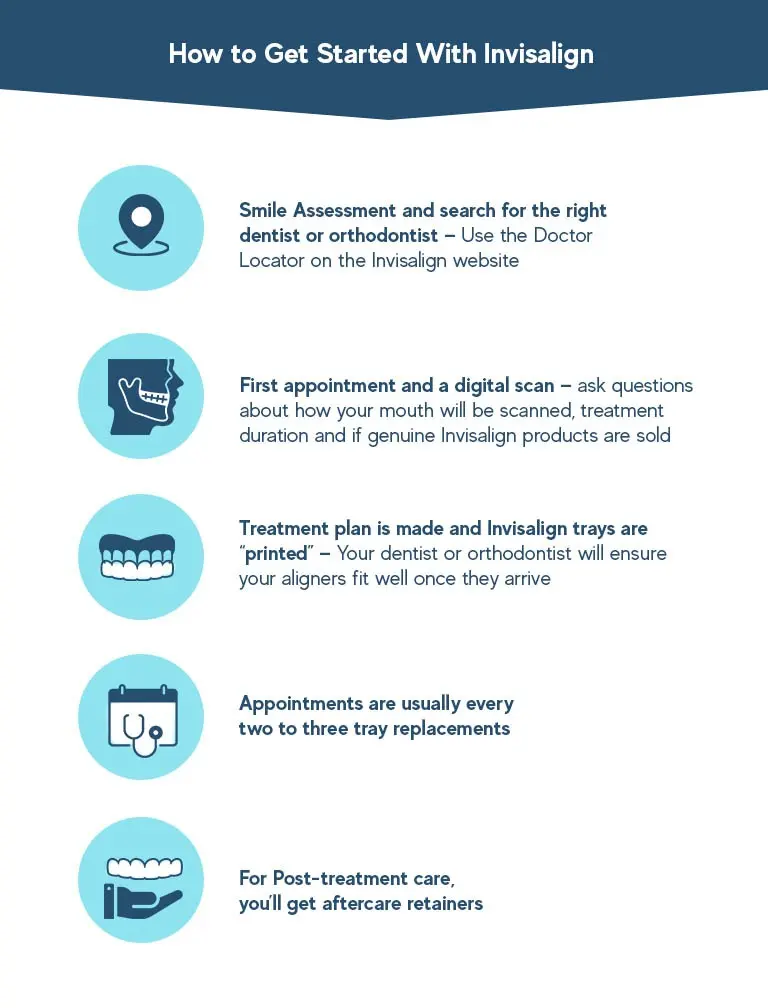
The Invisalign process begins with finding a suitable dentist or orthodontist. You can use the Doctor Locator on the Invisalign website to look for providers near your location.
The next step is an initial consultation and examination. Your dentist or orthodontist will assess your teeth, gums, bite, and overall oral health to determine whether clear aligners are suitable. It is worth asking how your teeth will be scanned, how long treatment may take, what the total cost includes, and whether additional procedures might be needed.
Instead of using a traditional impression, your provider may use an intraoral scanner to create a digital model of your teeth. ClinCheck software then helps the provider plan the movements needed to achieve the intended result.
The digital treatment plan can show a predicted outcome before you begin. Your provider can also determine whether a shorter Invisalign treatment option or a more comprehensive plan is appropriate. More complex cases, particularly those involving significant skeletal discrepancies, may require fixed braces, other orthodontic appliances, or surgical treatment.
If Invisalign is suitable for you, your treatment plan is prepared and your custom aligners are manufactured. Once they arrive, your dentist or orthodontist will check that they fit correctly and explain how to wear and maintain them.
Most patients are instructed to wear their aligners for approximately 20–22 hours per day, removing them for eating, drinking anything other than water, and cleaning their teeth. Depending on the treatment plan, aligners may be changed every one to two weeks, or according to the schedule provided by the treating clinician.
You may need fewer in-person appointments than with some fixed-brace treatment plans, although regular monitoring remains important. Some providers also offer virtual check-ins when appropriate.
Invisalign appointments are generally scheduled according to your individual treatment plan. During these visits, your provider checks your progress and makes adjustments if needed. Some patients require attachments to guide specific tooth movements. Others may need interproximal reduction, a carefully controlled removal of a small amount of enamel between selected teeth to create space for alignment.
After your aligner treatment is complete, you will need retainers to help keep your teeth in their new positions. Retainers are an essential part of orthodontic treatment because teeth can move again after active treatment. Your provider will explain how often to wear them; long-term retention, often including nighttime wear, is usually necessary.
What Can Invisalign Fix?
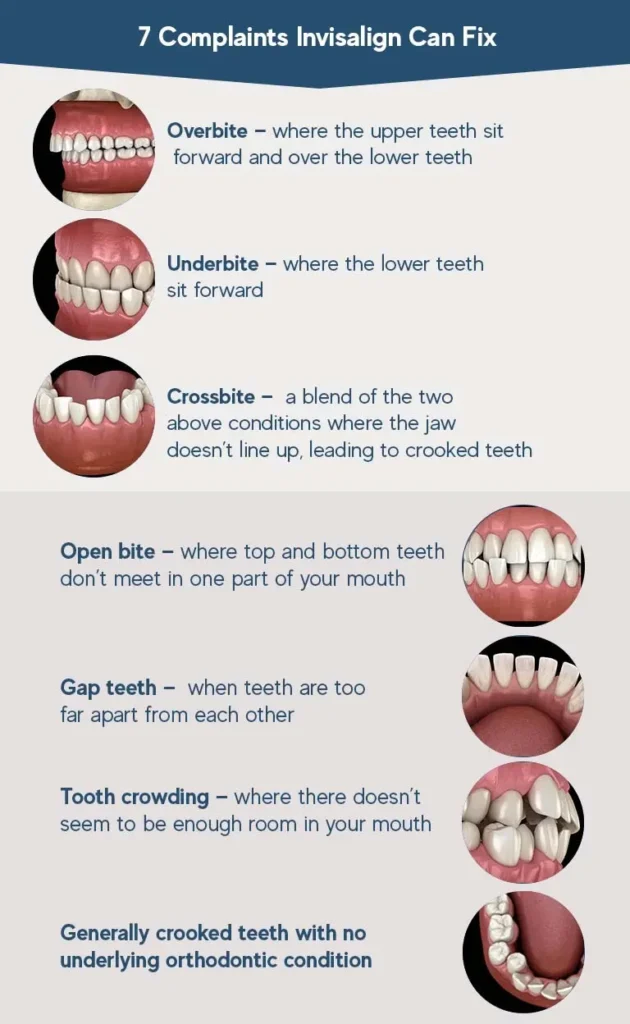
Invisalign can treat a range of orthodontic problems, depending on their severity and the patient’s individual needs. These include overbites, underbites, crossbites, open bites, gaps between teeth, and crowding. However, clear aligners are not suitable for every case, and a qualified orthodontist can help determine the most appropriate treatment option. For more information, read the American Association of Orthodontists’ guide to clear aligners.
- Overbite: When the upper front teeth overlap the lower front teeth excessively.
- Underbite: When the lower front teeth sit ahead of the upper front teeth.
- Crossbite: When some upper teeth bite inside the lower teeth rather than outside them.
- Open bite: When the upper and lower teeth do not meet in part of the mouth when the jaws are closed.
- Gap teeth: When there are excessive spaces between teeth.
- Tooth crowding: When there is insufficient space for teeth to align properly.
- Crooked teeth: When teeth are rotated, tilted, or otherwise misaligned.
The important question is not simply whether Invisalign can treat a particular condition, but whether it can predictably achieve the required tooth movements in your specific case.
Clinical research suggests that clear aligners can be effective for many mild-to-moderate orthodontic problems. However, their performance varies according to the movement required, case complexity, treatment planning, and patient compliance.
A 2025 systematic review and meta-analysis found that clear aligners were not significantly more effective than fixed appliances for simple, non-extraction cases, while the evidence for several other outcomes remained limited. A more recent systematic review also highlighted differences in the ability of clear aligners and fixed appliances to control particular tooth movements. Fixed braces may be preferable for some complex movements and extraction cases [1, 2].
To understand the different types of dental misalignment and their treatment options, read our guide to misaligned teeth and their treatments.
How Much Does Invisalign Cost?
The average Invisalign cost varies considerably depending on where you live, the complexity of your orthodontic problem, the number of aligners required, and the fees charged by your provider.
For patients in the United States, a reasonable 2026 estimate for in-office clear aligner treatment is approximately $3,500–$8,500. The final cost may fall outside this range, particularly for limited treatment or complex cases. Invisalign does not set one universal price for every patient; your provider determines the fee based on your treatment needs [3, 4].
Insurance may reduce the amount you pay if your plan includes orthodontic benefits. Some US dental insurance plans provide a fixed allowance or cover a percentage of eligible treatment costs, subject to policy limits. Many providers also offer monthly payment plans.
For example, if your treatment costs $5,000 and your insurance contributes $1,500, your remaining cost would be $3,500, assuming the full benefit applies and there are no additional charges.
Before starting treatment, ask whether the quoted price includes the initial examination, scans, aligners, attachments, refinement aligners, follow-up appointments, and retainers. These details can make a significant difference to the overall cost.
Prices in the United States should not be assumed to apply to other countries. If you are considering treatment in Ethiopia or elsewhere, ask a local Invisalign provider for a current quote in the local currency.
Invisalign Reviews 2026: What Are the Customers Saying?
Reviews for Invisalign online are mixed, with some patients reporting excellent results and others describing problems with treatment, costs, communication, or retainers.
Patient experiences can vary considerably because Invisalign treatment is provided through individual dental practices. The treating clinician, the initial diagnosis, the treatment plan, and the patient’s compliance can all influence the experience.
Invisalign Express Review
You may have heard of Invisalign Express, a shorter treatment option designed for selected patients who need limited orthodontic correction rather than comprehensive treatment.
The cost of Invisalign Express is usually lower than that of comprehensive Invisalign treatment, but there is no single fixed price across providers. As a rough US budgeting estimate, limited clear aligner treatment may cost approximately $1,500–$3,500, depending on the provider and what is included. Confirm the current price and availability of the specific Invisalign package with your local provider.
But is it worthwhile? Invisalign Express may be convenient for people who need relatively minor corrections. However, the shorter treatment plan does not necessarily mean fewer appointments or less monitoring in every case.
Eligibility is also limited. Patients with complex bite problems, substantial crowding, significant rotations, or extensive tooth movements may need a different treatment option.
What Is the Difference Between Invisalign Express and Invisalign Lite?
Invisalign has offered different treatment packages over time, including limited-treatment options and more comprehensive plans. The names, aligner limits, and availability of these packages can vary by market and may change.
Historically, Invisalign Lite was positioned between short Express treatment and comprehensive Invisalign treatment. It was intended for selected cases that required more correction than a very limited treatment plan but did not need full comprehensive treatment.
The appropriate option depends on the individual case rather than the product name alone. Your provider should explain how many aligners are included, what tooth movements can reasonably be achieved, whether refinements are available, and what happens if your teeth do not reach the planned positions.
A published case report described successful treatment of a patient with mild crowding and spacing using Invisalign Lite. The treatment involved wearing aligners for approximately 22 hours per day, changing them at the prescribed intervals, and performing limited interproximal reduction to create space.
Although the reported patient achieved a satisfactory result, a single case report cannot establish that the same treatment will work for everyone.
A shorter aligner plan may be suitable for minor relapse after previous orthodontic treatment or limited spacing and crowding. However, more significant rotations, bite discrepancies, and complex movements require careful assessment before a limited treatment package is selected.
Does Invisalign Express Work?
Invisalign Express can be effective in selected cases where only limited tooth movement is needed. However, success depends on whether the treatment plan matches the patient’s orthodontic needs.
A clinical case report or case series may demonstrate that a particular patient achieved a good result, but it cannot guarantee the same outcome for other patients.
Some orthodontists have also investigated techniques intended to accelerate tooth movement, including micro-osteoperforations. These procedures involve small perforations in the supporting bone and are not routine requirements for Invisalign treatment. Their benefits, risks, and suitability should be discussed with a qualified clinician rather than assumed to be necessary for successful treatment.
The key point is that Invisalign Express is not a substitute for comprehensive orthodontic treatment when the case requires extensive tooth movement or correction of a complex bite.
How Fast Is Invisalign Express?
The duration of Invisalign Express depends on the specific package, the movements required, and how well the teeth respond to treatment. Historically, some Express plans were marketed for relatively short treatment periods, but there is no single timeline that applies to every patient or market.
A minor correction may take only a few months, while more extensive treatment can take longer or require a different treatment plan altogether.
Positive Invisalign Express reviews often focus on the lower cost and shorter treatment period. These advantages can be meaningful when the patient’s misalignment is mild and the treatment goals are realistic.
Is Getting Invisalign Worth It?
Overall, Invisalign may be worth considering if you can afford it and have an orthodontic problem that can be treated effectively with clear aligners.
It is particularly useful for many patients with mild-to-moderate dental misalignment who prefer a less noticeable appliance. Some skeletal discrepancies can be partly camouflaged by moving the teeth, but this does not mean that clear aligners can correct every underlying jaw problem.
If you are considering straightening your teeth without professional supervision, it is important to understand the risks of trying to straighten teeth naturally. Unsupervised methods can damage your teeth and gums, so consult a qualified dental professional before attempting to move your teeth.
Invisalign is one of the most extensively studied clear aligner systems. Nevertheless, evidence supporting clear aligner treatment should not be interpreted as proof that it is always superior to traditional braces.
Recent systematic reviews suggest that both clear aligners and fixed appliances can achieve good orthodontic outcomes in appropriate cases. Some studies report advantages for aligners in comfort and oral hygiene, while fixed appliances may provide better control of certain complex movements. The overall quality of evidence varies across outcomes and study designs [1, 2].
If your orthodontic problem has a substantial skeletal component, Invisalign alone may not be sufficient. Depending on the diagnosis, treatment may involve fixed braces, growth modification in suitable younger patients, orthognathic surgery, or a combination of approaches.
A consultation with a qualified orthodontist can help determine which option is most likely to provide a stable and functional result.
Invisalign Pros and Cons
Just like any other orthodontic treatment, Invisalign aligners have their own advantages and disadvantages. What is right for you may not be the best choice for someone else.
What Are the Advantages of Invisalign?
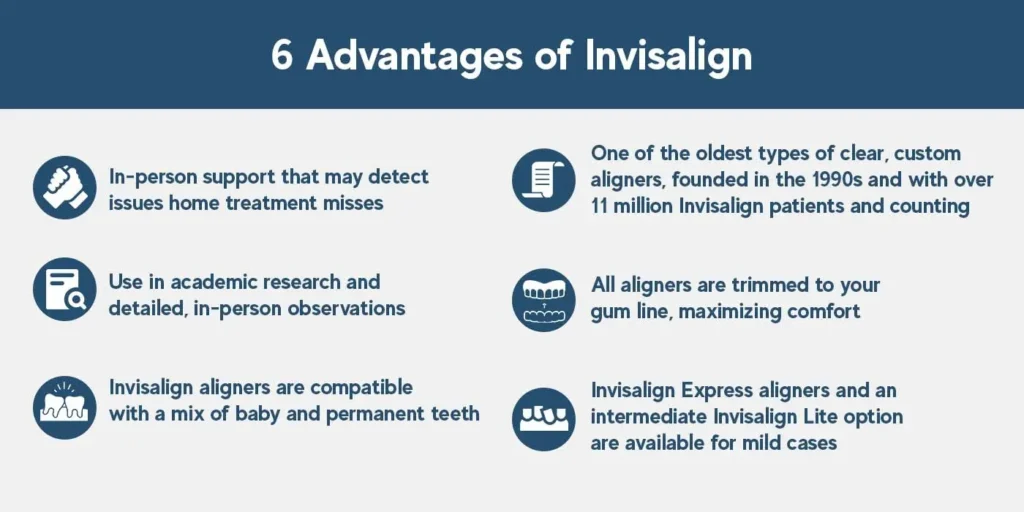
- Removable aligners: You can remove the trays for meals, drinking anything other than water, brushing, and flossing.
- Discreet appearance: The clear plastic is less noticeable than conventional metal braces.
- Professional supervision: Treatment is planned and monitored by a dental professional, allowing problems to be identified and managed.
- Digital treatment planning: Scanning and ClinCheck software help your provider plan tooth movements and show a predicted outcome.
- Options for different ages and needs: Invisalign offers treatment options for children, teenagers, and adults when clinically appropriate.
- Limited-treatment options: Selected patients may qualify for shorter treatment plans rather than comprehensive treatment.
- Potential oral hygiene advantages: Because aligners can be removed, brushing and flossing are generally easier than cleaning around fixed brackets and wires.
What Are the Disadvantages of Invisalign?
- Cost: Invisalign can be expensive, especially when extensive treatment or additional aligners are required.
- Access to a provider: You need an appropriately trained dental professional who can assess and monitor your treatment.
- Patient compliance: Aligners must be worn for the prescribed number of hours each day. Inconsistent wear can delay treatment or compromise the result.
- Daily inconvenience: You need to remove aligners before eating and drinking anything other than water, and clean your teeth before reinserting them.
- Not suitable for every case: Some complex tooth movements and skeletal discrepancies may be better managed with fixed appliances or combined treatment.
- Possible discomfort: Pressure, temporary soreness, speech changes, and irritation can occur, particularly when starting a new set of aligners.
- Retention requirements: You will need to wear retainers after active treatment to help prevent relapse.
Who Is a Candidate for Invisalign Express?
Invisalign Express should be considered only for patients whose orthodontic needs fall within the limits of the specific treatment package available in their market.
Historically, Express plans were intended for relatively minor alignment problems, such as small spaces, mild crowding, or limited relapse after previous orthodontic treatment. The exact eligibility criteria and allowable movements depend on the package and the treatment plan.
You may be a candidate if you previously wore braces and your teeth have shifted slightly, or if you have a small alignment problem that does not require extensive tooth movement.
However, only a clinical examination can determine whether limited treatment is appropriate. Your dentist or orthodontist should assess your bite, tooth positions, periodontal health, and overall treatment goals before recommending an Express plan.
FAQs
In short, what are the most important things we need to know about Invisalign?
Invisalign can be an effective alternative to traditional braces for many mild-to-moderate orthodontic problems. You can remove the aligners for meals and oral hygiene, and their clear appearance makes them less noticeable. However, they can be expensive, require consistent daily wear, and may not be the best option for complex tooth movements or significant jaw discrepancies. The right choice depends on your diagnosis, preferences, and treatment goals.
No, not as long as you brush your teeth after eating and drinking, and follow all other hygiene and treatment directions. On the other hand, standard braces are known to increase the risk of dental problems such as gingivitis (gum disease) and tooth decay, because of the dental bonding and increased difficulty when it comes to cleaning your teeth [2].
It is best to remove Invisalign aligners before drinking coffee or other beverages besides plain water. Hot drinks may distort the plastic, while coffee can stain the aligners. Remove your aligners before drinking coffee, and clean your teeth before reinserting them when possible. Follow your provider’s advice on cleaning your aligners and maintaining oral hygiene.
Invisalign may temporarily affect your speech, particularly when you first start wearing aligners. Some people notice a slight lisp or changes in pronunciation. These effects often improve as you adapt to wearing the trays. If speech problems persist or become particularly troublesome, ask your treating clinician to check the fit of your aligners.
Conclusion
When it comes to clear aligners, Invisalign works well for many people with crooked, crowded, or spaced teeth and selected bite problems. However, treatment costs, the need for consistent wear, and the requirement for professional monitoring may influence whether it is the right choice for you.
For a high-quality orthodontic result, the most important consideration is not simply the brand of aligner. It is the quality of the diagnosis, the suitability of the treatment plan, the experience of the treating professional, and your ability to follow the instructions.
References
- AlMogbel A, Alshawy ES, Alhusainy A. Efficacy of clear aligner therapy over conventional fixed appliances in controlling orthodontic movement: a systematic review. Journal of Orthodontic Science. 2024;13:23. doi:10.4103/jos.jos_176_23.
- Quality and stability of orthodontic treatment outcomes with clear aligners versus fixed appliances: a systematic review and meta-analysis. European Journal of Orthodontics. 2025. doi:10.1093/ejo/cjaf091.
- Dentaly.org. How much does Invisalign cost with or without insurance? Updated May 6, 2026. https://www.dentaly.org/us/invisalign-invisible-braces/invisalign-cost/
- Invisalign. Invisalign aligner treatment cost and payment information. https://www.invisalign.com/invisalign-cost

